
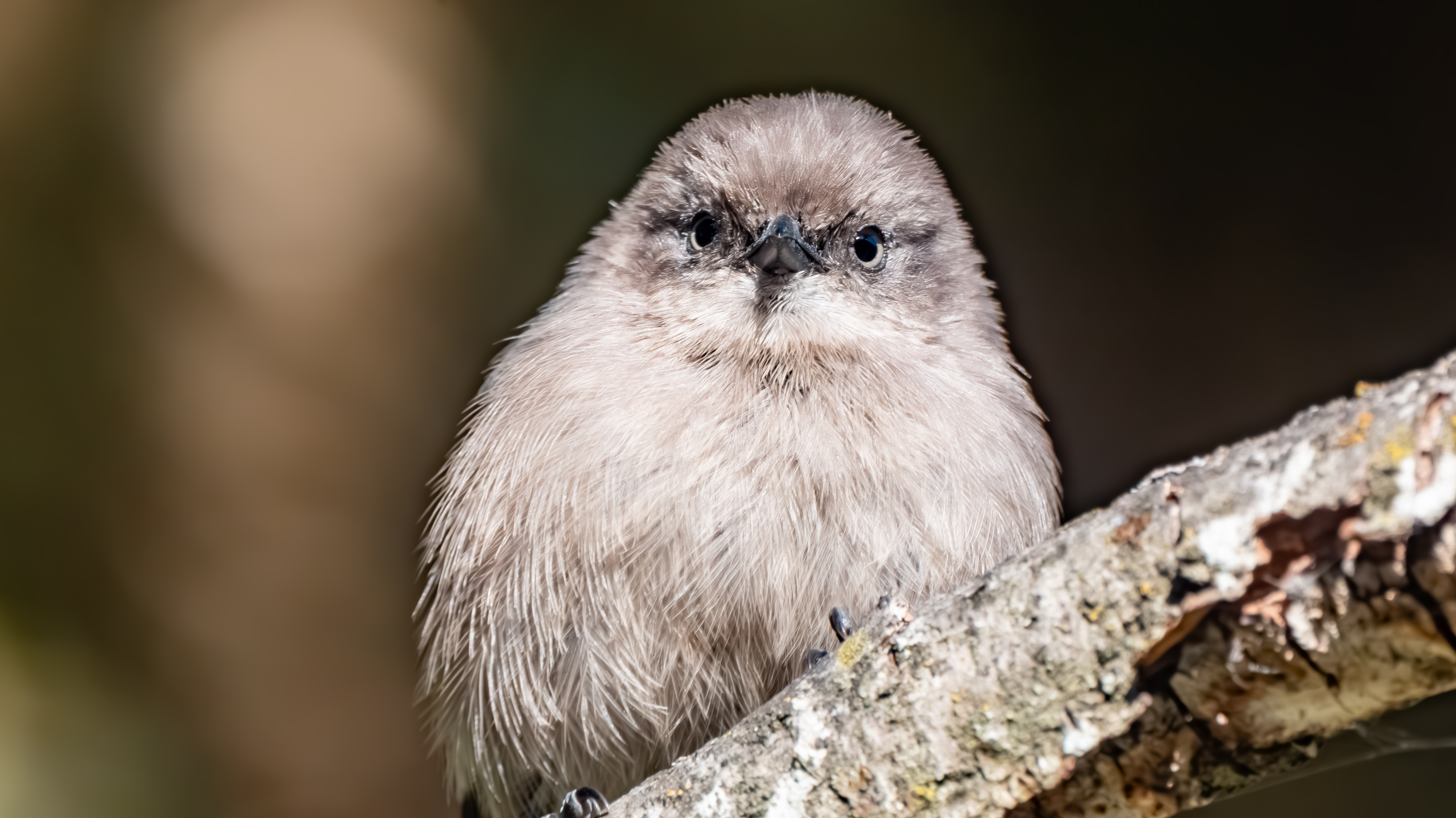
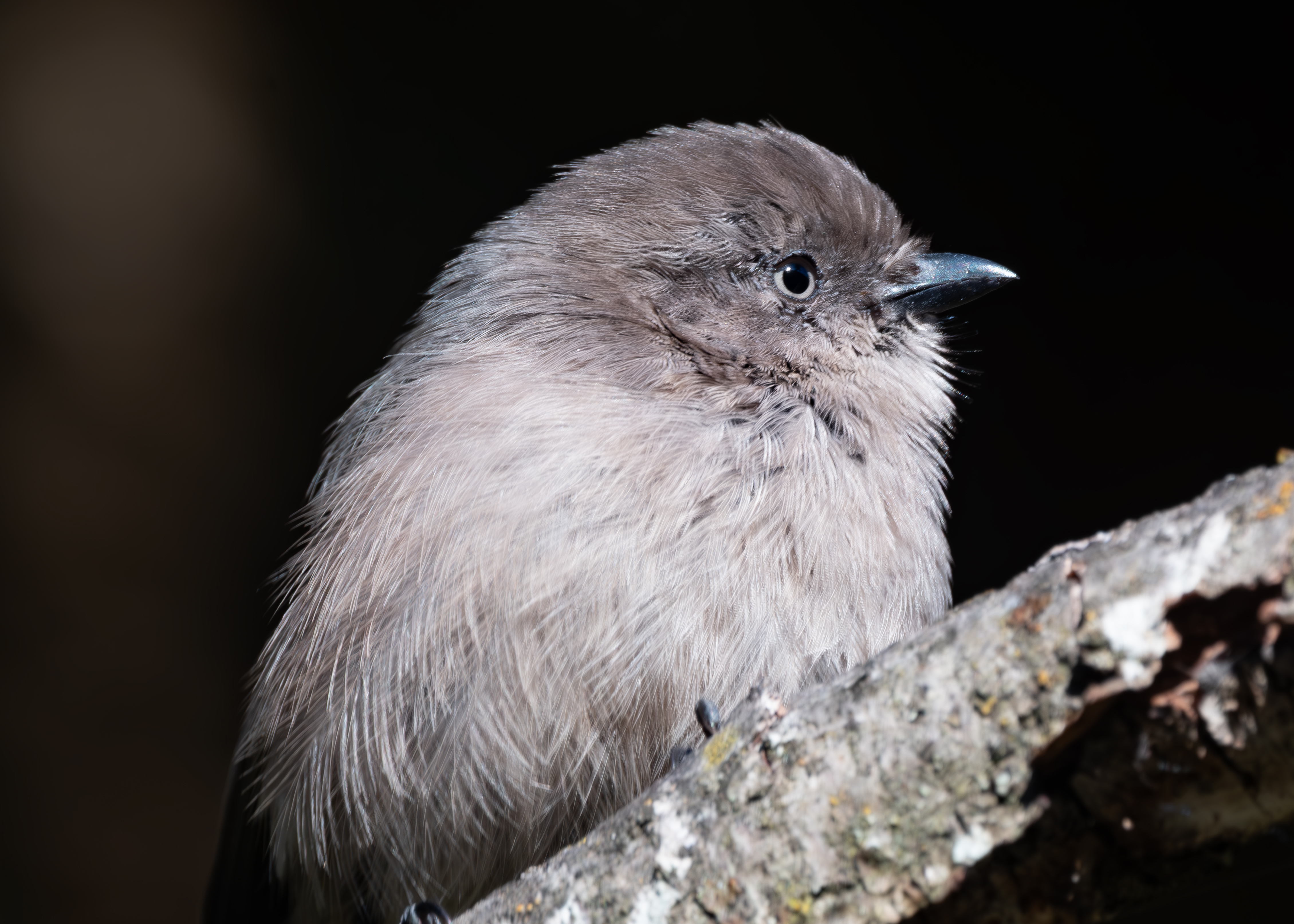
That afternoon in Sellwood was a beautiful fall day with perfect golden hour lighting. I was wandering through Sellwood Park and I noticed a high-pitched chatter. A busy, bouncing cloud of tiny gray fluff — American bushtits — was moving through the branches like confetti in slow motion. They were everywhere at once: hanging upside-down, probing bark crevices, and chasing one another along twigs. Up close, these little birds are impossible not to smile at — compact, round, and endlessly curious.
Quick ID and what they look like
– Common name: American bushtit. Scientific name: Psaltriparus minimus.
– Size: tiny — about 10–11 cm (4–4.5 in) long; weight only a few grams.
– Plumage: soft, overall grayish with warm buffish tones on some subspecies; heads may be slightly darker in some individuals. Juveniles are duller and fluffier.
– Distinctive look: short tail, round “ball” body when fluffed, very small bill, large expressive eyes relative to head size.
Behavior and social life
– Highly social: bushtits travel in loose, noisy flocks of a dozen to several dozen during the non-breeding season. In winter you’ll often see mixed-species flocks that include chickadees and nuthatches.
– Constant motion: they forage by gleaning insects and spiders from leaves and twigs, often hanging acrobatically — upside-down or sideways — to reach hidden morsels. Their movement is fast and frenetic, which is part of their charm.
– Vocal: a steady stream of thin “tsit” or “see-see” notes keeps the flock connected as it zips through foliage.
– Cooperative behavior: bushtits sometimes show cooperative breeding — helpers (often previous offspring or related individuals) may aid the breeding pair by feeding nestlings.
Nesting (the marvelous purse nest)
– Signature nest: a hanging, enclosed purse made of moss, lichen, plant down, and lots of spider silk; it can take the builders one to three weeks to complete and is often well-camouflaged.
– Interior is lined with soft feathers and plant down to cradle the young.
– Clutch size and development: clutches average several eggs (often 6–8), with incubation and nestling periods on the order of a couple of weeks each; fledging follows shortly thereafter. Exact timing varies with region and weather.
Diet
– Primarily tiny arthropods: insects, caterpillars, aphids, and spiders. They are ecological allies in controlling small pest populations on trees and shrubs.
Where to find them in Sellwood
– Bushtits favor riparian woods, willow and alder stands, and shrubby edges — exactly the kinds of habitats found near Oaks Bottom, Sellwood Riverfront Park, and other green pockets along the Willamette and local creeks.
– Best times: early morning and late afternoon when foraging activity is high, but they can be active throughout the day, especially in mild weather.
Photography tips for these tiny fluff balls
– Gear: a telephoto lens helps, but because bushtits are so small and quick, being close (with permission) or using a longer focal length (300mm+) will help fill the frame.
– Settings: high shutter speed (1/1000s or faster) to freeze hopping and wing flicks; continuous autofocus and burst mode to capture sequences; raise ISO as needed in low light.
– Composition: embrace the flock — capture group dynamics rather than only single birds. Tight portraits of a single bird perched or fluffed up can be charming, but shots of several clustered together show personality and behavior.
– Patience and stealth: they’re skittish but not overly so. Move slowly, keep branches between you and them when possible, and use quiet, controlled breathing to avoid startling the group.
Enjoying the free posts?
Every post on this blog is free and public — no paywall, no teaser. Membership is simply how it keeps going.
From $3/month you get 20–30% off everything in the print shop, member-only videos and photo sets, and free high-resolution downloads — and you help fund the wildlife photography, the conservation storytelling, and the WaveForge clean energy project.
Become a Member Already a Member? Log In🌿 Enjoying these posts?
This blog is free for everyone — and readers who become members help keep it going. Memberships start at \$3/month and include 20–30% off everything in the print shop.
Become a Member