The morning I found myself beside the water, camera in hand, I expected the usual solitary moments — a single heron standing like a statue, a kingfisher’s brief flash of blue. Instead the scene unfolded into something richer and kinder: a congregation of gray‑blue herons moving together like slow sentinels, a striking Great Egret wading nearby, a watchful kingfisher flashing from branch to splash, and, most unexpectedly, a raft of northern shovelers paddling contentedly beside a solitary coot. Different shapes, different colors, different ways of finding food and shelter — and yet, in that still light, they all fit together.
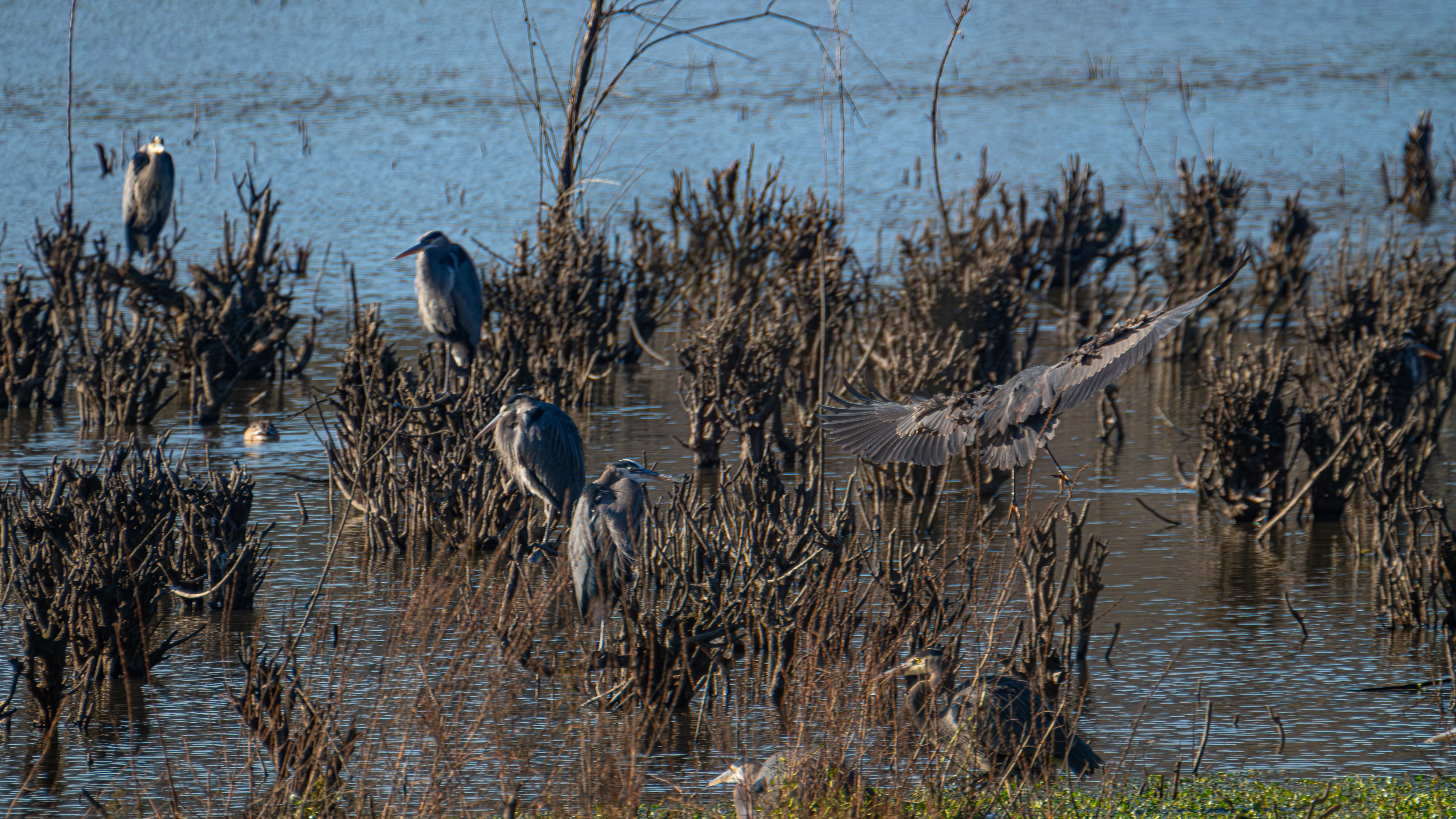
The herons were the unmissable anchors of the scene. Their long necks and solemn profiles cut precise silhouettes against the chill water. Where one stepped, another paused; where one folded its wings and waited, the flock became a mosaic of patient hunters. They were gray and blue in the soft hour, a muted patchwork against reeds and reflection. Photographing them felt like recording a ritual — long exposures for the slow grace, fast bursts for the sudden angle of a beak.
Nearby, the whit Great Egret caught and threw the light in a different way — brilliant, clean, a punctuation mark among the softer hues. The kingfisher provided a counterpoint: a concentrated bolt of movement and color, diving with machine‑precision, rising again with a silver prize. It came back to perch on a nearby branch. I carefully moved my camera in position, trying not to draw attention to myself, I was able to get a photo of this elusive bird. Kingfishers are very skittish birds and will rarely let you get within100 meters
But the image that stayed with me longest — and that I keep returning to when I look at the photos — is the one of the northern shovelers and the coot. Shovelers, with their broad, spoon‑shaped bills, bobbed and filtered, individually occupied yet unbothered by the coot nudging close. The coot, darker and more compact, brushed shoulders with the dabblers as if they had always been neighbors. There was no contest, no aggressive display — just a shared stretch of water and the simple acceptance that there was enough space and food for all.
That moment is what turned the morning into a lesson. In nature, species carry different anatomies, priorities, and survival strategies, and yet coexistence is often the default. Wetland communities are stitched together by tolerance and niche differentiation: one species sifts the surface, another plucks from the shallows, a third stands sentry. The result is a living, breathing mosaic that functions because each part plays its role without trying to be the other.
It’s hard not to see a human parallel. We too are a patchwork of perspectives, skills, and needs. Like the birds, we can choose to find the spaces that fit our strengths and allow room for others to do the same. The scene at the water’s edge suggested a model of peaceful cohabitation — not identicality, but mutual allowance; not competition at every turn, but a pragmatic, quiet sharing of resources and space.
For the photographer and the viewer, that message is attractive because it is simple and visual. A photograph of the shovelers and their coot neighbor can sit beside a close‑up of a heron’s eye and a kingfisher mid‑dive, and together they narrate a fuller story: diversity in form, unity in place. Captions can note species and behavior, but the image itself communicates what language sometimes cannot — that different beings can occupy the same scene with dignity.
In the end, I posted the images not only because they were beautiful, but because they mattered. The pictures were a reminder that coexistence is possible and observable right now, in places we might otherwise pass by. If humans can learn even a small part of that unassuming tolerance, the world would become more habitable for all its inhabitants.
Enjoying the free posts?
Every post on this blog is free and public — no paywall, no teaser. Membership is simply how it keeps going.
From $3/month you get 20–30% off everything in the print shop, member-only videos and photo sets, and free high-resolution downloads — and you help fund the wildlife photography, the conservation storytelling, and the WaveForge clean energy project.
Become a Member Already a Member? Log In🌿 Enjoying these posts?
This blog is free for everyone — and readers who become members help keep it going. Memberships start at \$3/month and include 20–30% off everything in the print shop.
Become a Member